01
Introduction
PROCUREMENT GUIDE

12 Questions to Ask Before Outsourcing Sterilisation Services

Selecting a sterilisation partner is more than comparing quotations. The right provider can support regulatory compliance, maintain product integrity, improve supply chain efficiency and contribute to successful product launches. Conversely, choosing a partner based solely on processing cost may introduce operational risks that become far more expensive over time.

Whether you manufacture pharmaceuticals, medical devices, biotechnology products or healthcare packaging, your sterilisation provider becomes an extension of your quality and supply chain operations. Asking the right questions during vendor evaluation helps procurement teams make informed, long-term decisions rather than short-term purchasing choices.

What This Guide Covers

This guide presents twelve practical questions that procurement professionals can use while evaluating any sterilisation service provider. Rather than recommending a specific company, it focuses on the areas that influence quality, compliance, operational efficiency and long-term business continuity.

02
Question 1
REGULATORY COMPLIANCE

1. Is the Facility Appropriately Licensed and Compliant?

Regulatory compliance forms the foundation of every sterilisation partnership. Procurement teams should understand whether the provider operates under the required regulatory approvals and maintains a quality system appropriate for the products being processed.

Questions to Ask

  • Which regulatory approvals does the facility operate under?
  • What quality management systems are implemented?
  • How are audits managed?
  • Can documentation be provided when required?
Why it matters: A compliant facility reduces regulatory risk while supporting confidence throughout product manufacturing and distribution.
03
Question 2
TECHNOLOGY

2. Is the Selected Sterilisation Technology Appropriate for Your Product?

Different products require different sterilisation technologies. Material compatibility, packaging configuration and product functionality should all be considered before selecting a processing method.

Questions to Ask

  • Which sterilisation technology is recommended?
  • Has the product been evaluated for compatibility?
  • Will validation support be required?
  • Are there any product-specific considerations?
04
Question 3
VALIDATION SUPPORT

3. Can the Provider Support Validation Activities?

For many regulated products, sterilisation extends beyond routine processing. Procurement teams should understand whether the provider can support validation-related activities required during product development and commercial production.

Consider Discussing

  • Dose establishment
  • Dose mapping
  • Validation protocols
  • Technical documentation
  • Support during audits
05
Question 4
DOCUMENTATION

4. What Documentation Accompanies Every Processed Batch?

Clear documentation supports traceability, regulatory inspections and quality assurance. Procurement teams should understand what records accompany every processed shipment.

Typical Documentation

  • Processing certificates
  • Batch records
  • Dosimetry reports (where applicable)
  • Product identification records
  • Shipment documentation
06
Question 5
TRACEABILITY

5. How Is Product Traceability Maintained Throughout the Process?

From receipt through dispatch, products should remain identifiable throughout the sterilisation process. Effective traceability supports investigations, audits and quality assurance.

Look For

  • Unique batch identification
  • Controlled product movement
  • Documented processing history
  • Shipment traceability
07
Question 6
TURNAROUND

6. What Turnaround Time Can the Provider Consistently Deliver?

Processing time is only one component of turnaround. Scheduling, logistics, documentation and communication all influence how quickly products return to your manufacturing or distribution network.

Questions Worth Asking

  • What are the normal turnaround times?
  • How are urgent requirements managed?
  • How are schedule changes communicated?
  • Is capacity available during peak demand?
08
Question 7
COMMUNICATION

7. How Are Deviations, Delays and Unexpected Events Communicated?

Every supply chain occasionally encounters unexpected situations. What differentiates a reliable sterilisation partner is not the absence of challenges, but the speed, transparency and professionalism with which they are communicated and managed.

Questions to Ask

  • How are unexpected delays communicated?
  • Is there a designated point of contact?
  • How are quality deviations documented?
  • How quickly are customers informed?
Why it matters: Transparent communication enables procurement, production planning and quality teams to respond proactively rather than react after production schedules have already been affected.
09
Question 8
CAPACITY

8. Can the Facility Support Your Future Growth?

The right sterilisation partner should be capable of supporting your business not only today but also as production volumes increase over time.

Discuss Topics Such As

  • Available processing capacity
  • Peak demand planning
  • Future expansion capability
  • Business continuity planning
10
Question 9
MATERIAL HANDLING

9. How Are Materials Handled Before and After Sterilisation?

Material handling extends far beyond loading products into a processing chamber. Receiving, segregation, storage, identification and dispatch all contribute to product integrity and operational efficiency.

Questions to Ask

  • How are incoming and processed products segregated?
  • Are storage areas organised and clearly identified?
  • How are products tracked throughout movement?
  • Are loading and unloading activities well controlled?
Procurement Insight: Efficient material handling reduces unnecessary movement, minimises the risk of product mix-ups and supports faster turnaround throughout the supply chain.
11
Question 10
SUPPLY CHAIN

10. Can the Provider Support Your Broader Supply Chain?

Modern procurement extends beyond purchasing a service. Organisations increasingly value partners who understand logistics, documentation and supply chain coordination alongside technical processing.

Consider Discussing

  • Transportation coordination
  • Export documentation support
  • Warehousing options
  • Integration with existing logistics partners
  • Shipment planning
Think Beyond Processing: An efficient sterilisation partner contributes to smoother product movement across the supply chain—not simply the sterilisation step itself.
12
Question 11
INFRASTRUCTURE

11. Does the Facility Infrastructure Support Efficient Vehicle Movement?

Infrastructure influences turnaround just as much as processing capacity. Efficient vehicle movement helps minimise waiting times, improves scheduling and supports predictable logistics operations.

Things Worth Evaluating

  • Ease of truck access
  • Loading and unloading facilities
  • Internal vehicle movement
  • Waiting time management
  • Dispatch efficiency
13
Question 12
LONG-TERM PARTNERSHIP

12. Is This a Partner You Can Grow With?

A sterilisation provider should support your organisation beyond the first purchase order. Long-term partnerships are built on trust, responsiveness, technical support and the ability to adapt as business requirements evolve.

Evaluate

  • Responsiveness
  • Technical expertise
  • Communication quality
  • Scalability
  • Commitment to continuous improvement
14
Summary
FINAL THOUGHTS

Choosing a Sterilisation Partner Is a Strategic Decision

While processing cost is an important consideration, procurement decisions should also account for compliance, quality systems, documentation, logistics, material handling and the provider's ability to support future business growth.

The right questions help procurement teams identify partners capable of delivering not only compliant sterilisation services but also dependable operational support throughout the product lifecycle. A thoughtful evaluation process can reduce risk, improve supply chain efficiency and contribute to long-term business success.
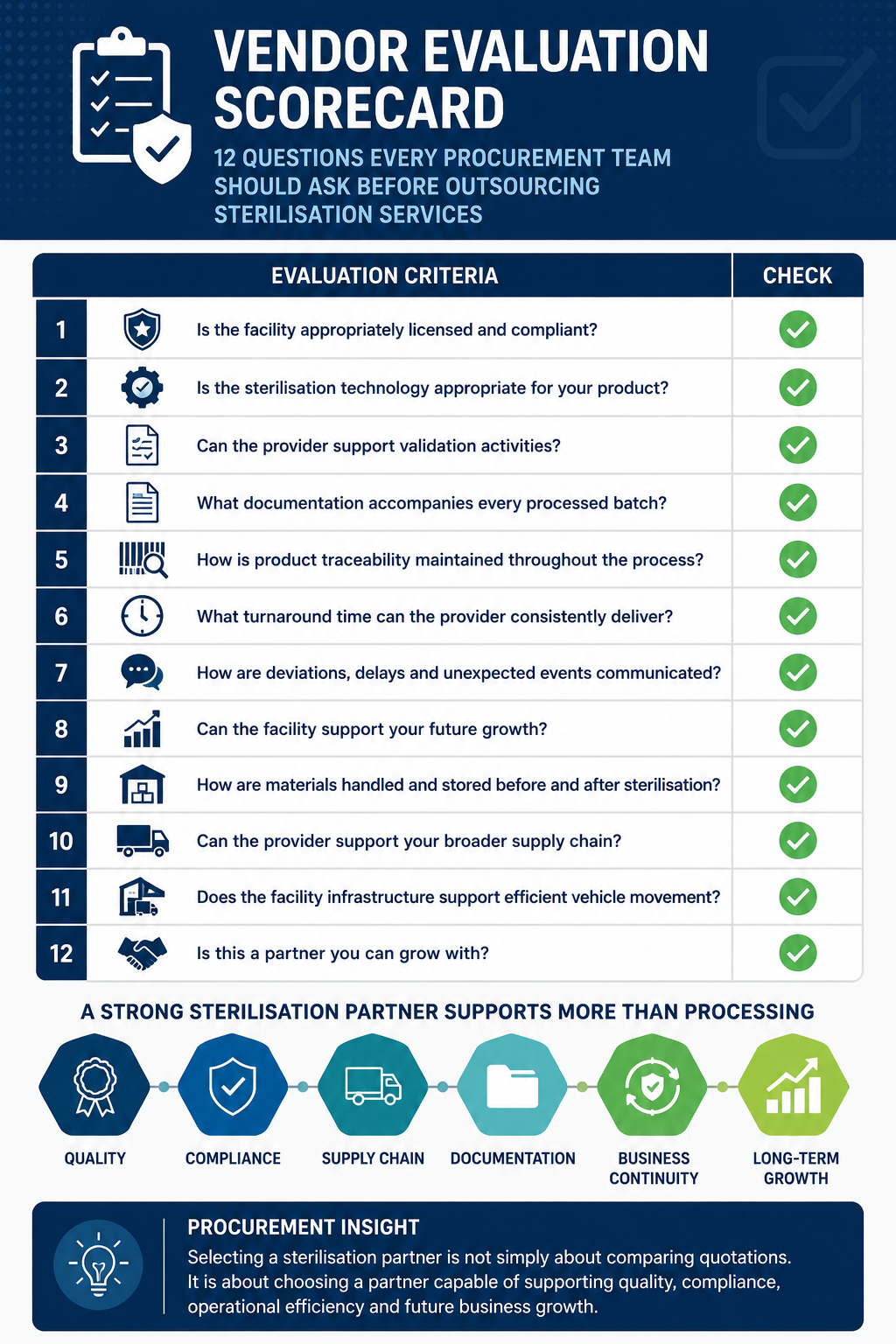
Vendor evaluation scorecard for outsourcing sterilisation services, highlighting 12 key procurement criteria including compliance, validation, documentation, traceability, material handling, supply chain support and infrastructure.

Figure 1. Procurement scorecard highlighting twelve practical evaluation criteria that organisations can use when selecting an outsourcing partner for sterilisation services.

Quick Procurement Checklist

  • ✔ Regulatory compliance
  • ✔ Appropriate sterilisation technology
  • ✔ Validation support
  • ✔ Documentation & traceability
  • ✔ Reliable turnaround times
  • ✔ Transparent communication
  • ✔ Capacity for growth
  • ✔ Material handling practices
  • ✔ Supply chain support
  • ✔ Infrastructure & vehicle movement
  • ✔ Long-term partnership potential

Vishvesh Agromed Private Limited (VAPL) is a strategic sterilisation partner providing Contract Sterilisation Services, Dose Mapping & Validation, Dose Establishment Studies, and Radiation Dosimetry Services for medical devices, pharmaceuticals, packaging materials, food products and industrial applications.

Address