Gamma Sterilisation of IV Cannulas: Supporting Safe Intravenous Therapy
IV cannula sterilisation is a critical stage in medical device manufacturing. Gamma sterilisation enables terminal sterilisation after final packaging while supporting ISO 11137 validation, Sterility Assurance Level (SAL), radiation dosimetry, dose mapping and reliable high-volume production of sterile single-use intravenous cannulas.
Intravenous (IV) cannulas are among the most frequently used single-use medical devices in hospitals and healthcare facilities. They provide reliable vascular access for administering medicines, intravenous fluids and blood products, making sterility an essential requirement throughout the product lifecycle. Gamma sterilisation enables manufacturers to sterilise IV cannulas after final packaging while supporting validated radiation processing, material compatibility and regulatory compliance.
Executive Insight
Safe intravenous therapy begins long before a cannula reaches a patient. Validated gamma sterilisation, supported by dose establishment, dose mapping and radiation dosimetry, helps manufacturers consistently deliver sterile medical devices while maintaining product quality and packaging integrity.
Why IV Cannulas Require Terminal Sterilisation
IV cannulas are designed to penetrate the skin and provide direct vascular access, making sterility one of their most critical quality attributes. Because these devices come into contact with the bloodstream, manufacturers implement validated terminal sterilisation processes to minimise microbial contamination risks and support safe clinical use. Healthcare guidance consistently emphasizes aseptic practice and the use of sterile, single-use cannulas during intravenous therapy. :contentReference[oaicite:1]{index=1}
Gamma sterilisation enables IV cannulas to be sterilised after complete assembly and final packaging. This approach helps preserve the sterile barrier system during storage, transportation and distribution while reducing the possibility of recontamination before clinical use.
Why Gamma Sterilisation is Widely Used for IV Cannulas
Gamma sterilisation has become a widely adopted terminal sterilisation technology for disposable IV cannulas because of its ability to penetrate packaged product loads and deliver a validated sterilisation dose without introducing chemical residues. The process is well suited to high-volume medical device manufacturing where consistency, traceability and regulatory compliance are essential.
| Gamma Sterilisation Advantage | Benefit for IV Cannula Manufacturers |
|---|---|
| Terminal Sterilisation | Sterilisation after complete assembly and final packaging. |
| Deep Radiation Penetration | Effective processing of packaged product loads. |
| Residue-Free Process | No chemical sterilant residues remain on finished devices. |
| High Processing Capacity | Supports commercial-scale medical device manufacturing. |
| Validated Processing | Supports ISO 11137 compliant validation and routine monitoring. |
Material Compatibility of IV Cannulas with Gamma Sterilisation
IV cannulas are manufactured using carefully selected medical-grade polymers and stainless-steel components that are evaluated for compatibility with validated radiation sterilisation. Before routine commercial processing begins, manufacturers conduct material compatibility studies to verify that the selected sterilisation dose does not adversely affect mechanical performance, dimensional stability, catheter flexibility or packaging integrity.
These evaluations help ensure that gamma sterilisation consistently achieves the required Sterility Assurance Level (SAL) while preserving the functional performance expected from a single-use sterile medical device throughout its intended shelf life.
| IV Cannula Component | Typical Material | Validation Objective |
|---|---|---|
| Catheter Tube | Medical Grade Polyurethane / FEP | Flexibility, Tensile Strength & Dimensional Stability |
| Cannula Hub | Medical Grade Polypropylene | Structural Integrity & Mechanical Performance |
| Injection Port | Medical Grade Polymer | Leak Tightness & Functional Performance |
| Needle | Stainless Steel | Mechanical Integrity & Corrosion Resistance |
| Primary Packaging | Medical Grade Film / Tyvek® | Sterile Barrier System Integrity |
Material Compatibility is an Essential Part of Validation
Radiation compatibility studies confirm that IV cannulas continue to meet their intended performance requirements after gamma sterilisation. These studies form an important part of product validation before routine commercial sterilisation begins.
Dose Mapping and Radiation Process Validation
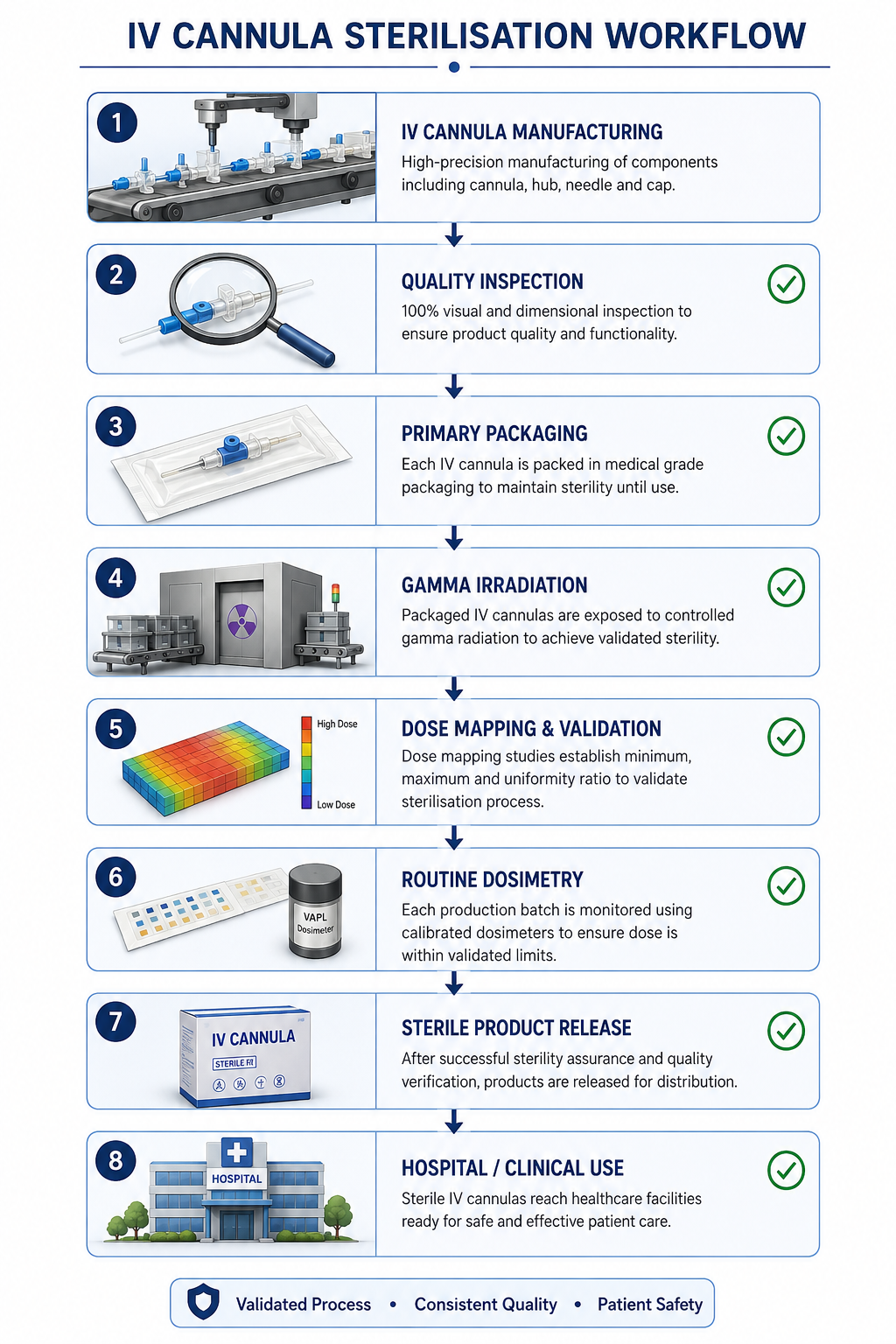
Successful gamma sterilisation depends upon delivering the required radiation dose consistently throughout every packaged product load. Because IV cannulas vary in packaging configuration, density and loading pattern, manufacturers perform Dose Mapping studies to determine the minimum absorbed dose, maximum absorbed dose and Dose Uniformity Ratio (DUR) for the validated product configuration.
Radiation dosimetry is then used throughout routine production to verify that every processing cycle delivers the validated sterilisation dose. Together, dose establishment, dose mapping and routine dosimetry form the scientific foundation of radiation sterilisation validation in accordance with ISO 11137. ISO 11137 provides requirements for development, validation and routine control of radiation sterilization processes, with supporting guidance covering dose establishment, dosimetry and process control. :contentReference[oaicite:0]{index=0}
Executive Insight
Gamma sterilisation is much more than exposing products to radiation. It is a validated manufacturing process supported by dose establishment, dose mapping, radiation dosimetry and routine monitoring to ensure repeatable sterilisation performance and consistent product quality.
International Standards Supporting IV Cannula Sterilisation
Manufacturers generally establish their radiation sterilisation programme using internationally recognised standards that govern validation, routine process control, quality management systems and sterile barrier packaging for medical devices.
| Standard | Purpose |
|---|---|
| ISO 11137 | Development, validation and routine control of radiation sterilisation processes for medical devices. |
| ISO 13485 | Quality Management Systems for medical device manufacturers. |
| ISO 11607 | Validation of sterile barrier packaging systems. |
| FDA Guidance | Regulatory expectations for sterile medical devices. |
| EU MDR | Medical device regulatory compliance requirements. |
Frequently Asked Questions
Why is gamma sterilisation preferred for IV cannulas?
Gamma sterilisation enables terminal sterilisation after final packaging, provides deep penetration through packaged medical devices and leaves no chemical sterilant residues, making it suitable for high-volume IV cannula manufacturing.
Can gamma sterilisation affect IV cannula materials?
Medical device manufacturers perform material compatibility studies during validation to confirm that the selected radiation dose maintains catheter performance, packaging integrity and functional characteristics.
Why is Dose Mapping important?
Dose Mapping demonstrates how radiation is distributed throughout the packaged product load and confirms that every IV cannula receives the validated sterilisation dose during routine production.
Does gamma sterilisation leave chemical residues?
No. Gamma sterilisation is a physical radiation process that sterilises medical devices without introducing chemical sterilants or leaving residual compounds on the finished product.
Key Takeaways
Gamma sterilisation has become one of the preferred terminal sterilisation technologies for IV cannulas because it enables sterilisation after final packaging, supports ISO 11137 compliant validation, achieves the required Sterility Assurance Level (SAL) and delivers reliable, repeatable processing for large-scale medical device manufacturing. When combined with dose establishment, dose mapping and radiation dosimetry, it provides manufacturers with a scientifically validated approach to producing sterile IV cannulas for safe intravenous therapy.
About Vishvesh Agromed Private Limited
Vishvesh Agromed Private Limited (VAPL) operates a purpose-built Gamma Radiation Processing Facility within the MIHAN Special Economic Zone (SEZ), Nagpur, providing contract gamma sterilisation services for medical devices, pharmaceutical products, biotechnology applications and healthcare packaging. VAPL also supports manufacturers through Dose Mapping & Validation, Dose Establishment Studies and Radiation Dosimetry services to help establish validated and compliant radiation sterilisation programmes.