Gamma Sterilisation of Tubing Assemblies for Pharmaceutical Applications
Disposable tubing assemblies have transformed sterile fluid handling across modern pharmaceutical manufacturing.
From media transfer and buffer preparation to vaccine production and aseptic filling, single-use tubing assemblies enable closed fluid pathways that reduce contamination risks while improving manufacturing efficiency.
Unlike reusable stainless-steel piping, disposable tubing systems eliminate cleaning validation, reduce downtime between production batches and simplify manufacturing operations within highly regulated pharmaceutical environments.
To ensure these assemblies are supplied ready for sterile use, manufacturers commonly employ gamma sterilisation after final assembly and packaging.
Gamma sterilisation enables complete tubing assemblies—including tubing, connectors, clamps, filters and manifolds—to be sterilised within their final sealed packaging, maintaining sterility until the point of use.
What are Disposable Tubing Assemblies?
Disposable tubing assemblies are pre-manufactured sterile fluid transfer systems consisting of pharmaceutical-grade tubing integrated with connectors, clamps, filters, sampling ports and other components required for aseptic processing.
These assemblies are custom designed to match specific manufacturing processes and are widely adopted throughout biopharmaceutical production facilities operating under GMP conditions.
Silicone Tubing
Flexible tubing for sterile liquid transfer throughout pharmaceutical processes.
Aseptic Connectors
Maintain closed-system connections during fluid transfer.
Tube Clamps
Provide controlled flow regulation and secure line isolation.
Filters
Integrated filtration for sterile manufacturing operations.
Sampling Ports
Enable sterile sample collection during production.
Custom Assemblies
Configured according to specific pharmaceutical process requirements.
Tubing assemblies support sterile fluid transfer throughout pharmaceutical manufacturing.
These disposable systems are used wherever sterile liquids must be transferred safely between process equipment while maintaining a closed manufacturing environment.
Common applications include media preparation, buffer transfer, upstream bioprocessing, downstream purification, filtration, formulation, vaccine manufacturing, aseptic filling, cell and gene therapy production and biologics manufacturing.
By replacing reusable pipework with disposable systems, manufacturers improve operational flexibility while reducing cleaning requirements and contamination risks.
Gamma sterilisation enables complete tubing assemblies to be supplied ready for immediate pharmaceutical use.
Because gamma radiation penetrates sealed packaging, manufacturers can sterilise finished tubing assemblies after final packaging without reopening the system, helping preserve sterility throughout transportation and storage.
This makes gamma irradiation an effective terminal sterilisation technology for complex disposable fluid transfer assemblies used throughout the global pharmaceutical and biotechnology industries.
Terminal gamma sterilisation supports reliable delivery of ready-to-use sterile tubing assemblies while simplifying pharmaceutical manufacturing workflows and maintaining supply chain integrity.
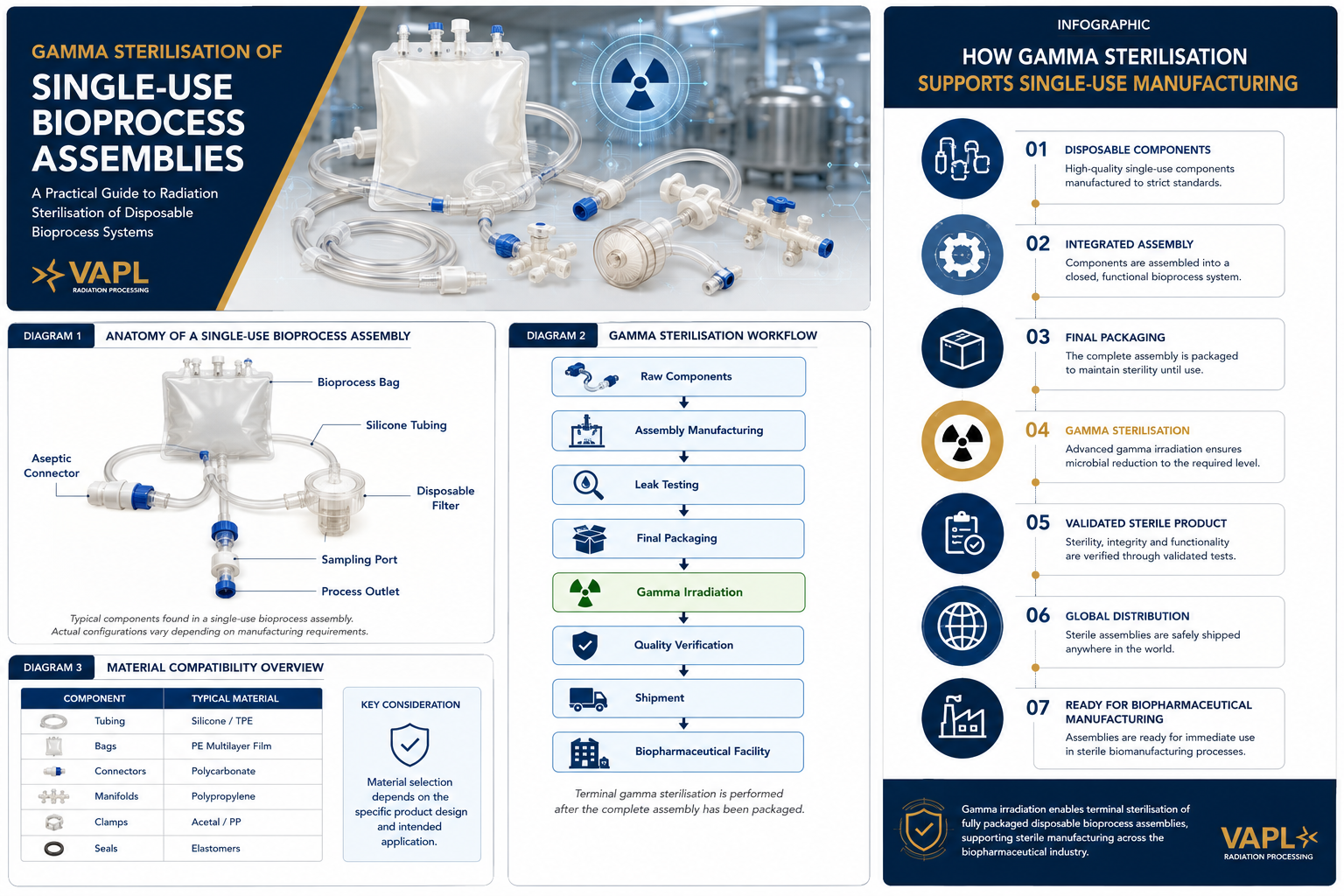
Gamma sterilisation enables complete disposable tubing assemblies to be supplied sterile and ready for pharmaceutical and biopharmaceutical fluid transfer applications.
```Tubing assemblies are manufactured from pharmaceutical-grade materials selected for compatibility, flexibility and process reliability.
Every component within a disposable tubing assembly must maintain its functional performance before, during and after sterilisation while remaining compatible with sensitive pharmaceutical products.
Depending upon the application, assemblies may incorporate silicone tubing, thermoplastic elastomers (TPE), PVC, polyolefins, polypropylene fittings, polycarbonate connectors, PVDF components and high-performance filtration media. Material selection depends upon fluid compatibility, pressure requirements, flexibility, extractables and leachables profiles and intended process use.
Silicone
Highly flexible tubing widely used for sterile pharmaceutical fluid transfer.
TPE
Thermoplastic elastomers provide excellent weldability and flexibility.
Polypropylene
Frequently used for connectors, fittings and manifold components.
Successful gamma sterilisation requires a validated process supported by robust quality systems.
Validation demonstrates that tubing assemblies can be sterilised consistently while maintaining their intended functional performance throughout commercial manufacturing.
Validation activities generally consider assembly configuration, packaging orientation, radiation dose distribution, component functionality, packaging integrity and routine process monitoring. Manufacturers also evaluate extractables and leachables, connector integrity, tubing flexibility and weld performance as appropriate for the product design.
Every tubing assembly should be validated in its final packaged configuration because geometry, component density and packaging arrangement can influence dose distribution during irradiation.
Each tubing assembly presents unique design and sterilisation considerations.
Because tubing assemblies vary considerably in length, diameter, fittings and complexity, manufacturers evaluate several factors during product development and commercial production.
Assembly Length
Long assemblies require appropriate packaging and dose evaluation.
Component Density
Multiple connectors and fittings may influence product geometry.
Packaging Design
Packaging should protect the sterile product during storage and transportation.
Material Compatibility
Material performance should remain suitable for the intended application after sterilisation.
Supply Chain
Ready-to-use assemblies reduce manufacturing preparation time.
Documentation
Comprehensive quality records support regulatory compliance and customer confidence.
Common questions about gamma sterilisation of pharmaceutical tubing assemblies.
Why are tubing assemblies gamma sterilised?
Gamma sterilisation enables complete disposable assemblies to be supplied sterile and ready for immediate use in pharmaceutical manufacturing.
Can complete tubing systems be sterilised?
Yes. Tubing, connectors, clamps, filters and manifolds can be sterilised together as complete packaged assemblies following validated radiation processing.
Does packaging matter?
Yes. Final packaging contributes to product protection, sterility maintenance and consistent radiation processing during commercial sterilisation.
Where are tubing assemblies commonly used?
They are widely used throughout pharmaceutical manufacturing, biotechnology, vaccine production, biologics processing, cell and gene therapy and aseptic filling operations.
Gamma sterilisation plays an essential role in delivering sterile disposable tubing assemblies for pharmaceutical manufacturing.
As single-use manufacturing technologies continue to expand, sterile tubing assemblies will remain fundamental to efficient, flexible and contamination-controlled pharmaceutical production.
Selecting an appropriate sterilisation process involves careful consideration of assembly design, materials, packaging configuration and validated manufacturing processes to ensure reliable product performance and regulatory compliance.
Discover more technical resources covering gamma sterilisation, disposable fluid transfer systems, bioprocessing technologies and pharmaceutical packaging solutions.
Continue Reading
Gamma Sterilisation of Single-Use Bioprocess Assemblies
Understand sterilisation principles for complete disposable bioprocess systems.
Gamma Sterilisation of Single-Use Bioprocess Bags
Explore the role of gamma irradiation in sterile disposable bag manufacturing.
Gamma Sterilisation of Disposable Manifolds
Learn how manifold assemblies support complex sterile fluid transfer operations.