Cost vs Compliance: Choosing the Right Sterilisation Partner
When organisations evaluate sterilisation partners, the first comparison is usually the processing fee. While pricing is an important consideration, it represents only one part of the overall procurement decision. Choosing a sterilisation partner involves balancing commercial value with quality, compliance, operational efficiency and long-term supply chain performance.
Sterilisation influences far more than product processing. It affects inventory planning, logistics, regulatory documentation, batch release, customer commitments and production schedules. Procurement teams that evaluate the complete picture are better positioned to make decisions that support both immediate operational needs and long-term business objectives.
Key Takeaway
The processing fee is only one component of the total cost of outsourcing sterilisation services. Hidden costs—including logistics, documentation, delays, inventory holding and compliance—often have a greater impact on overall business performance than the quoted processing rate alone.
The Processing Fee Is Only One Component of Total Cost
For many procurement teams, supplier evaluation begins with comparing processing charges. While this is a logical starting point, it rarely reflects the complete financial impact of outsourcing sterilisation services. Transportation, inventory, scheduling, documentation and coordination all contribute to the total cost of ownership.
A sterilisation partner should be evaluated not only on the price quoted today but also on the value delivered throughout the product lifecycle. A slightly higher processing fee may ultimately reduce operational costs by improving logistics, documentation, turnaround time and supply chain efficiency.
Direct Costs Commonly Evaluated
- Processing charges
- Transportation costs
- Packaging requirements
- Loading and unloading expenses
- Warehousing charges
Hidden Costs That Procurement Teams Often Overlook
- Inventory carrying costs
- Administrative coordination
- Production schedule changes
- Shipment delays
- Extended storage
- Customer commitment risks
- Internal follow-ups and documentation effort
Procurement Insight
The objective is not simply to secure the lowest processing fee—it is to minimise the overall cost of delivering a compliant product to the customer. Looking beyond the quotation helps organisations make decisions that support long-term operational efficiency.
Compliance Is an Investment—Not an Expense
Compliance activities are often perceived as additional cost centres during supplier evaluation. In reality, robust quality systems and consistent documentation frequently reduce operational disruptions, simplify audits and minimise regulatory risk throughout the supply chain.
Choosing a sterilisation partner with established quality practices can help organisations avoid costly investigations, documentation gaps and unnecessary delays. Strong compliance supports smoother product release while improving confidence among customers, auditors and regulatory authorities.
Business Benefits of Strong Compliance
- Improved audit readiness
- Consistent documentation
- Reduced investigation effort
- Enhanced product traceability
- Greater customer confidence
- Predictable operational performance
Remember
The cost of non-compliance is rarely visible in the original quotation. It often appears later through delayed product release, additional investigations, repeated documentation requests or supply chain disruptions.
Operational Delays Can Cost More Than Processing
In many manufacturing environments, sterilisation is positioned near the end of the production cycle. A delay at this stage can affect multiple downstream activities, including product release, distribution schedules, export commitments and customer deliveries. These indirect costs often exceed the difference between competing processing quotations.
Rather than evaluating turnaround time as an isolated service metric, procurement teams should consider its broader influence on business continuity. Reliable scheduling, proactive communication and predictable processing contribute to smoother operations across the supply chain.
Why This Matters
A delay of even one or two days may appear insignificant in isolation, but when combined with inventory holding, transportation rescheduling and production planning adjustments, the financial impact can become substantial.
| Potential Delay | Possible Business Impact |
|---|---|
| Delayed Product Release | Finished inventory remains unavailable for shipment, delaying revenue recognition and customer fulfilment. |
| Missed Export Shipment | Additional freight costs, revised shipping schedules and potential disruption to overseas customer commitments. |
| Manufacturing Schedule Changes | Production planning adjustments, idle resources and reduced operational efficiency. |
| Extended Storage | Higher warehousing costs and increased inventory carrying expenses. |
| Additional Documentation Follow-ups | Extra administrative effort by procurement, QA and supply chain teams. |
| Customer Delivery Rescheduling | Potential impact on customer confidence and future production planning. |
Questions Procurement Teams Should Consider
- What turnaround time can the provider consistently achieve?
- How are urgent or priority requirements managed?
- How are delays communicated to customers?
- Is there visibility into processing schedules?
- Can the provider support changing production priorities?
Procurement Perspective
The processing quotation represents only one financial figure. The real commercial impact of outsourcing sterilisation is determined by how effectively the provider supports your production schedule, logistics network and customer commitments throughout the product lifecycle.
The Invoice Rarely Represents the Total Cost
At this stage, it becomes clear that outsourcing sterilisation services involves far more than comparing processing quotations. Procurement decisions influence logistics, inventory, production planning, customer commitments and regulatory compliance. Each of these factors contributes to the overall commercial outcome of the partnership.
Looking beyond the invoice enables procurement teams to evaluate suppliers based on long-term operational value rather than short-term cost alone. A well-selected sterilisation partner contributes to supply chain reliability, predictable operations and sustained business growth.
The Hidden Cost Framework
When evaluating quotations, consider how each supplier performs across the following areas—not just on processing price.
| Visible Cost | Hidden Business Cost |
|---|---|
| Processing Fee | Inventory carrying cost |
| Transportation | Delivery schedule disruption |
| Warehousing | Extended storage time |
| Documentation | Administrative effort and audit preparation |
| Validation Activities | Delayed product release |
| Multiple Handling Points | Longer turnaround and operational complexity |
| Poor Communication | Production planning uncertainty |
| Limited Capacity | Business continuity risk during peak demand |
Questions Every Procurement Team Should Ask
- What costs are visible in the quotation?
- Which operational costs are not immediately visible?
- Will this partnership simplify our supply chain?
- Can this provider support future business growth?
- Will this decision reduce risk over the next five years—not just the next purchase order?
Logistics Can Significantly Influence the Total Cost of Sterilisation
For many organisations, the sterilisation process begins long before products enter the irradiation chamber. Transportation, scheduling, vehicle movement and shipment planning all contribute to the overall efficiency of outsourcing. These activities influence both operational performance and total cost of ownership.
A competitively priced quotation may become considerably more expensive when repeated transportation, inefficient routing, excessive waiting time or multiple handling points are introduced into the supply chain. Procurement teams should therefore evaluate how effectively a sterilisation partner integrates with existing logistics operations rather than viewing transportation as an isolated expense.
Think Beyond Transportation Costs
Logistics should be evaluated as an operational system rather than a freight expense. Efficient coordination between manufacturing, transportation and sterilisation can reduce delays, improve inventory movement and simplify production planning.
Questions Procurement Teams Should Ask
- How far is the sterilisation facility from our manufacturing plant?
- Can transportation schedules be coordinated with production planning?
- Will products require multiple loading and unloading activities?
- Can urgent consignments be accommodated?
- How are inbound and outbound shipments planned?
- Does the provider assist with logistics coordination when required?
Logistics Factors That Influence Total Cost
- Transportation distance
- Transit time
- Vehicle waiting time
- Loading and unloading efficiency
- Shipment planning
- Freight consolidation opportunities
- Export logistics coordination
- Administrative follow-up
| Logistics Consideration | Potential Business Impact |
|---|---|
| Long Transportation Distance | Higher freight costs and longer lead times. |
| Multiple Handling Points | Additional labour, greater coordination effort and increased operational complexity. |
| Poor Vehicle Scheduling | Waiting time for trucks, delayed unloading and reduced productivity. |
| Limited Shipment Planning | Inconsistent turnaround and avoidable supply chain delays. |
| Lack of Logistics Coordination | Higher administrative workload and fragmented communication. |
Efficient Material Handling and Storage Reduce Operational Risk
Material handling begins the moment a shipment reaches the sterilisation facility and continues until the processed products leave the premises. Every stage—including receiving, identification, storage, internal movement and dispatch—contributes to operational efficiency and product integrity.
Although material handling is often viewed as an operational activity, it has a direct impact on procurement objectives. Well-organised product flow can reduce unnecessary handling, minimise administrative effort and support predictable turnaround times across the supply chain.
Think Beyond Storage Space
Material handling is not simply about where products are stored. It also involves how efficiently they move through the facility, how clearly they are identified and how effectively incoming and processed materials are managed.
Questions Procurement Teams Should Ask
- How are incoming consignments received?
- How are products identified throughout processing?
- Are processed and unprocessed materials physically segregated?
- What storage arrangements are available before and after sterilisation?
- How is internal product movement managed?
- How efficiently are products prepared for dispatch?
Material Handling Factors That Influence Cost
- Receiving efficiency
- Storage management
- Product identification and traceability
- Segregation of processed and unprocessed materials
- Internal material movement
- Loading and unloading practices
- Dispatch readiness
- Minimising unnecessary handling steps
| Material Handling Activity | Business Value |
|---|---|
| Structured Receiving Process | Faster unloading and improved shipment visibility. |
| Clearly Identified Products | Improved traceability and reduced administrative effort. |
| Segregated Storage Areas | Reduced risk of product mix-ups and simplified quality control. |
| Efficient Internal Material Flow | Reduced handling time and smoother operational movement. |
| Planned Dispatch Activities | Predictable shipment schedules and improved logistics coordination. |
Good Documentation Creates Operational Value
Documentation is frequently viewed as a regulatory requirement, yet its business value extends much further. Well-organised records support product release, simplify audits, improve traceability and reduce administrative effort across procurement, quality assurance and supply chain functions.
Incomplete or inconsistent documentation can delay product release, increase follow-up communication and consume valuable resources across multiple departments. Procurement teams should therefore evaluate documentation quality as part of the overall value offered by a sterilisation partner.
Documentation Is More Than Compliance
Accurate records support operational efficiency, customer confidence and regulatory readiness while reducing unnecessary administrative workload throughout the product lifecycle.
Questions Procurement Teams Should Ask
- What documentation accompanies every processed batch?
- How quickly are processing certificates issued?
- How is product traceability maintained?
- Can historical processing records be retrieved efficiently?
- How are documentation revisions controlled?
- Who should be contacted if additional records are required?
Documentation That Adds Business Value
- Processing certificates
- Batch records
- Product traceability records
- Shipment documentation
- Validation support documents
- Quality records
- Processing history
- Customer communication records
| Documentation Practice | Business Benefit |
|---|---|
| Complete Batch Records | Supports quicker product review and release activities. |
| Consistent Traceability | Simplifies investigations and regulatory inspections. |
| Well-Organised Processing Records | Reduces administrative follow-up and improves efficiency. |
| Prompt Documentation Availability | Helps avoid unnecessary delays in downstream operations. |
| Controlled Record Management | Improves confidence during customer and regulatory audits. |
Capacity, Planning and Business Continuity Matter as Much as Price
Selecting a sterilisation partner is not only about meeting today's production requirements. Procurement teams should also consider whether the provider can support future growth, seasonal demand, changing production schedules and unforeseen business challenges. Capacity planning plays a critical role in maintaining supply chain resilience.
A supplier with appropriate capacity planning, structured scheduling and effective communication can help organisations minimise production interruptions and respond more confidently to changing market conditions. These advantages often become evident only after the partnership has begun, making them important considerations during vendor selection.
Business Continuity Begins During Vendor Selection
Capacity is not simply a measure of throughput. It reflects a provider's ability to accommodate changing priorities, unexpected demand and long-term business growth while maintaining consistent service quality.
Questions Procurement Teams Should Ask
- Can the facility support projected business growth?
- How are peak production periods managed?
- What scheduling flexibility is available for urgent requirements?
- How are customers informed about capacity constraints?
- What contingency plans exist for unexpected disruptions?
- Can production forecasts be incorporated into planning?
Capacity Planning Considerations
- Available processing capacity
- Production forecasting
- Peak demand management
- Scheduling flexibility
- Business continuity planning
- Operational scalability
- Communication during high-demand periods
- Long-term partnership potential
| Planning Consideration | Business Advantage |
|---|---|
| Forecast-Based Scheduling | Improves planning accuracy and reduces operational uncertainty. |
| Scalable Processing Capacity | Supports future business growth without major operational changes. |
| Flexible Scheduling | Allows quicker response to changing production priorities. |
| Business Continuity Planning | Helps minimise disruption during unforeseen events. |
| Long-Term Capacity Planning | Builds confidence for sustained outsourcing partnerships. |
The Lowest Quotation Is Not Always the Lowest Total Cost
Price is one of the easiest procurement parameters to compare because it is clearly visible on every quotation. Value, however, is created by the combined effect of compliance, documentation, logistics, planning, communication, material handling and long-term operational reliability. These factors influence business performance long after the processing invoice has been paid.
Rather than selecting a supplier solely on the basis of the lowest processing charge, procurement professionals should evaluate the overall contribution a sterilisation partner can make towards supply chain efficiency, quality assurance and business continuity.
From Price Comparison to Value Evaluation
The objective of procurement is not simply to reduce today's expenditure. It is to maximise long-term business value while managing operational risk, regulatory obligations and customer expectations.
| Price-Focused Decision | Value-Focused Decision |
|---|---|
| Lowest processing quotation | Lowest total cost of ownership |
| Short-term savings | Long-term operational efficiency |
| Transaction-based relationship | Strategic partnership |
| Processing viewed as a standalone activity | Sterilisation integrated into the overall supply chain |
| Limited evaluation criteria | Balanced assessment of quality, logistics and compliance |
| Reactive purchasing decisions | Planned procurement strategy |
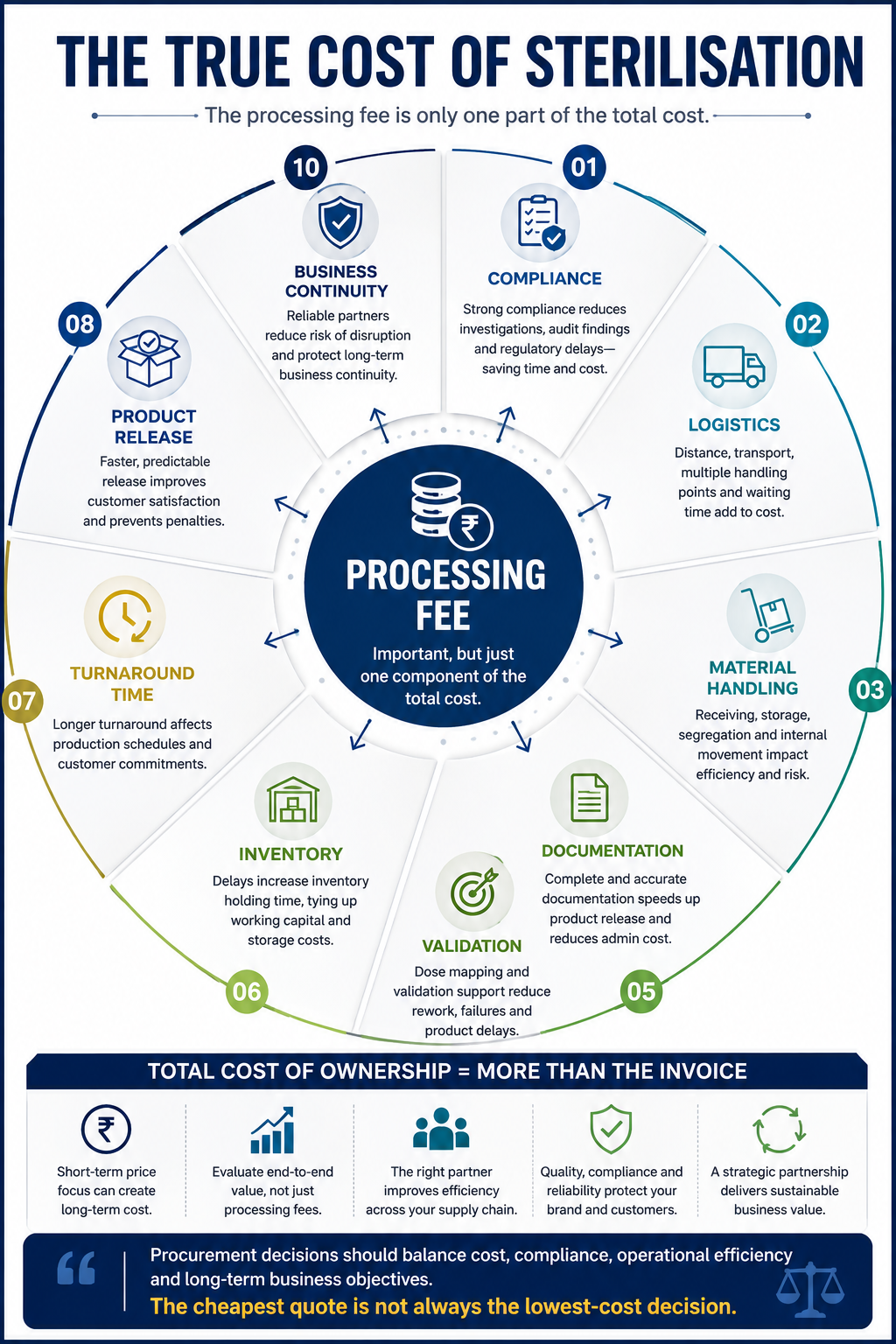
Figure 1. Total Cost of Ownership (TCO) infographic illustrating why the processing fee is only one component of the overall cost of outsourced sterilisation services.
A Practical Procurement Checklist
- ✔ Compare total cost—not only the processing fee.
- ✔ Consider logistics and transportation efficiency.
- ✔ Review documentation and traceability capabilities.
- ✔ Assess compliance and quality systems.
- ✔ Evaluate material handling and storage practices.
- ✔ Understand scheduling flexibility and capacity.
- ✔ Consider long-term business continuity.
- ✔ Select a partner capable of supporting future growth.
Building Value Beyond the Processing Fee
Outsourcing sterilisation services is a strategic procurement decision that extends well beyond comparing quotations. Processing cost is only one component of a much broader equation that includes compliance, logistics, documentation, material handling, planning and long-term operational reliability.
By evaluating suppliers through a total cost of ownership perspective, organisations can make more informed decisions that support product quality, regulatory confidence, resilient supply chains and sustainable business growth. The right sterilisation partner is not necessarily the one offering the lowest processing fee—it is the one capable of delivering consistent value throughout the product lifecycle.
Key Takeaways
- ✔ Evaluate the total cost of ownership.
- ✔ Consider compliance alongside commercial value.
- ✔ Review logistics, documentation and material handling.
- ✔ Assess planning, scalability and business continuity.
- ✔ Build long-term partnerships rather than transactional relationships.
- ✔ Balance cost, quality and operational efficiency in every procurement decision.