EtO vs Gamma Irradiation for Spices: How to Choose the Right Processing Method
Choosing a microbial control process for spices is no longer simply a question of which technology reduces microbial load. Manufacturers must also consider product characteristics, export-market requirements, residue considerations, packaging, validation, documentation and the practical requirements of their supply chain.
EtO vs Gamma Irradiation
Spice Irradiation
Gamma Irradiation of Spices
Ethylene Oxide for Spices
Microbial Control
Food Irradiation
Spice Export Compliance
Radiation Processing
For spice manufacturers, exporters and food ingredient companies, selecting the right processing method requires a product-specific and market-specific assessment. Ethylene oxide (EtO) fumigation and gamma irradiation are different technologies with different process characteristics. Understanding those differences can help manufacturers make a more informed decision based on their microbial control objective, destination market and operational requirements.
The Decision Is Bigger Than Microbial Reduction
A suitable spice processing method should be evaluated against the complete commercial requirement: microbial control, product and packaging compatibility, regulatory expectations, destination-market requirements, documentation and routine process control. The objective is not simply to choose a technology, but to choose a process that fits the product and the market in which it will be sold.
Why Spice Manufacturers Are Reconsidering Their Processing Options
Spices are agricultural products and can carry microorganisms introduced through cultivation, harvesting, handling, processing, storage and transportation. Manufacturers therefore need effective methods for controlling microbial contamination while maintaining the required quality and compliance characteristics of the finished ingredient.
The choice of processing technology becomes particularly important when spices are manufactured for export markets. Regulatory requirements, residue limits and testing expectations can vary between destinations, making the treatment decision part of a broader food-safety and supply-chain strategy.
India has introduced measures specifically addressing the risk of EtO contamination in spice exports, including mandatory pre-shipment sampling and testing for exports to Singapore and Hong Kong and supply-chain guidelines covering sourcing, packaging, transportation and testing. Different markets may also apply different maximum residue limits for EtO.
What Manufacturers Should Ask
“Which processing method is most appropriate for my spice product, target market and microbial control requirement?”
That is the right question to ask before choosing between EtO and gamma irradiation.
EtO vs Gamma Irradiation: The Fundamental Difference
Ethylene oxide and gamma irradiation approach microbial control through fundamentally different mechanisms. EtO is a chemical fumigation process, while gamma irradiation uses ionising radiation under controlled processing conditions.
| Factor | EtO Processing | Gamma Irradiation |
|---|---|---|
| Processing Principle | Chemical fumigation using ethylene oxide. | Physical processing using ionising radiation. |
| Microbial Control | Used for reducing microbial contamination in suitable products. | Used for reducing microbial contamination in suitable products through controlled radiation exposure. |
| Residue Consideration | Residual EtO and related reaction products must be considered and controlled according to applicable requirements. | The process does not introduce EtO as a chemical fumigant. |
| Post-Processing Considerations | Process conditions and aeration requirements need to be considered. | Radiation processing does not require EtO aeration. |
| Process Control | Requires controlled chemical processing and appropriate monitoring. | Requires controlled radiation processing, dosimetry and process validation. |
| Product Suitability | Depends on product characteristics and applicable regulatory requirements. | Depends on product characteristics, packaging and validated radiation-processing conditions. |
The EtO Residue Question
One of the most important considerations when evaluating EtO for spices is the regulatory treatment of residues. EtO requirements are not necessarily identical across markets, meaning that a processing method suitable for one destination may require additional evaluation when the product is exported elsewhere.
For manufacturers supplying multiple international markets, this creates an important procurement and compliance consideration: the selected processing method needs to be evaluated against the requirements of each intended destination rather than against a single universal standard.
Export Markets Matter
The regulatory environment surrounding EtO residues has received increased attention in Indian spice exports. Manufacturers should therefore establish the applicable requirements for their target market before finalising a processing strategy.
Where Gamma Irradiation Fits Into the Decision
Gamma irradiation provides a physical processing alternative for suitable spice products. Instead of introducing a chemical fumigant, the product is exposed to ionising radiation under controlled and validated processing conditions.
For manufacturers considering gamma irradiation, the evaluation should include the product’s initial microbial condition, packaging configuration, product density, required processing objective and the characteristics that need to be maintained after processing.
Radiation processing is therefore not simply a matter of selecting a nominal dose. A suitable programme requires product-specific assessment, dose establishment, dosimetry and appropriate process controls.
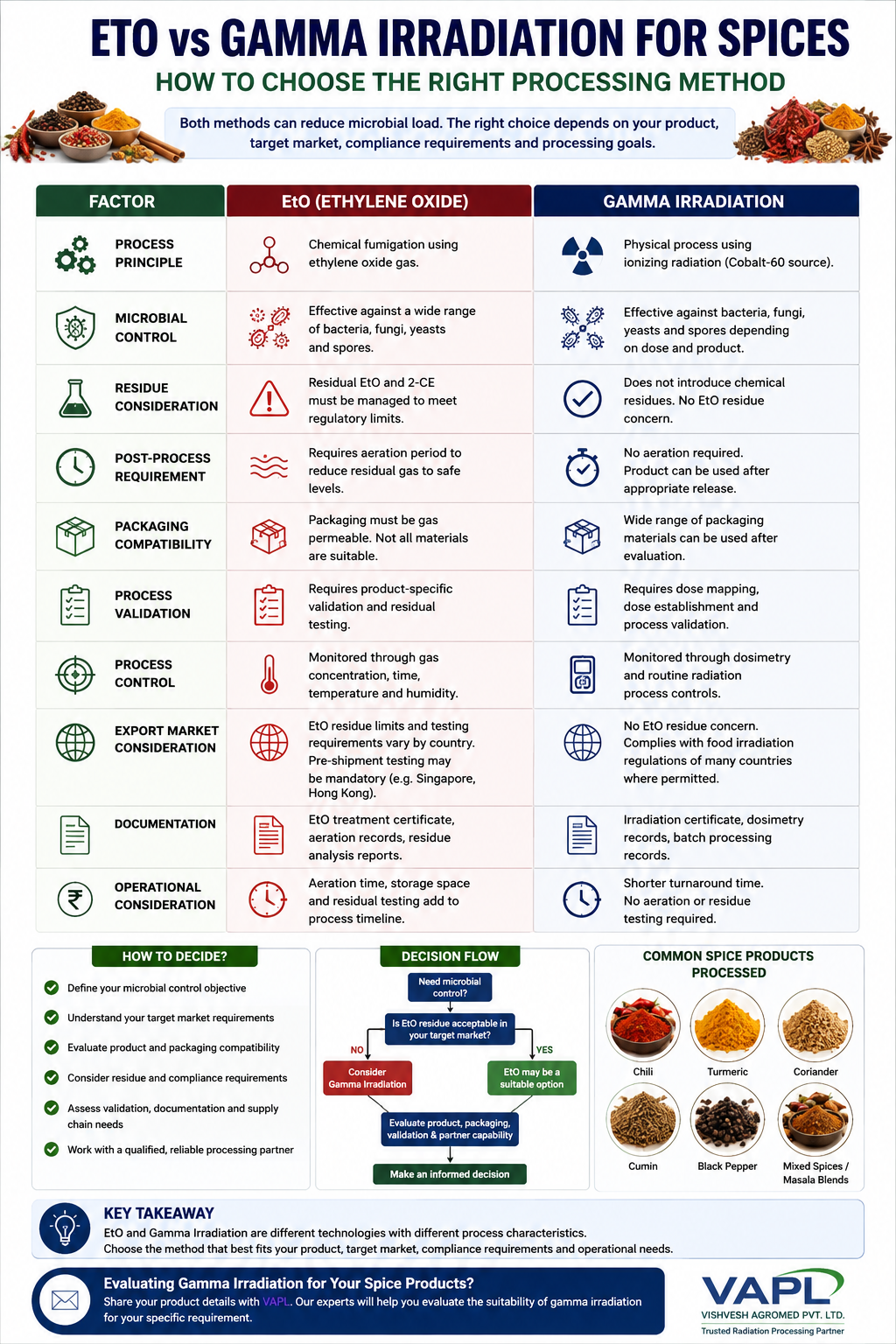
Figure 1.
EtO and gamma irradiation comparison for spice processing, highlighting microbial control, residue considerations, packaging compatibility, validation, export-market requirements and key factors manufacturers should evaluate before selecting a processing method.
What Should Manufacturers Evaluate Before Choosing a Processing Method?
The choice between EtO and gamma irradiation should be based on the specific requirements of the spice product and its intended market. Manufacturers should consider the microbiological objective, product characteristics, packaging, regulatory requirements and the documentation expected by customers or importing authorities.
| Evaluation Area | Why It Matters |
|---|---|
| Product Type | Whole spices, powders and blended masalas can have different processing characteristics and microbiological profiles. |
| Initial Microbial Load | Understanding the starting microbial condition helps establish an appropriate processing strategy. |
| Target Market | Destination countries may have different food-safety, residue and import requirements. |
| Packaging | The packaging system needs to be suitable for the selected processing method and intended supply chain. |
| Processing Objective | The required microbial reduction and product quality objectives should be defined before processing. |
| Validation & Testing | The selected process needs appropriate validation, monitoring and microbiological evaluation. |
| Documentation | Processing records and test documentation can be important for quality assurance and export supply chains. |
Gamma Irradiation: What Manufacturers Need to Evaluate
For spice manufacturers considering gamma irradiation, the process begins with understanding the product and its intended processing objective. Product composition, initial microbial condition, packaging configuration and loading characteristics can influence the development of a suitable radiation processing programme.
Dose establishment and dosimetry are important components of radiation processing. Dose mapping can also be used to understand dose distribution within the product and packaging configuration being evaluated.
The objective is to establish a controlled and reproducible process that achieves the intended microbial control outcome while maintaining the required characteristics of the spice product and its packaging.
Gamma Irradiation Is Product-Specific
There is no single radiation treatment that should automatically be applied to every spice. Product-specific evaluation is important because different spices, blends, packaging configurations and processing objectives may require different process conditions.
EtO vs Gamma: Which Factors Should Drive the Decision?
There is no universal answer to the EtO-versus-gamma question. The appropriate choice depends on the manufacturer’s product, market and processing requirements.
| Decision Factor | Question for the Manufacturer |
|---|---|
| Microbial Objective | What level and type of microbial control is required? |
| Export Destination | What requirements apply in the countries where the product will be sold? |
| Residue Requirements | Are EtO residue limits or testing requirements relevant to the target market? |
| Product Compatibility | Can the product and packaging withstand the selected process while maintaining required quality attributes? |
| Process Validation | Can the selected treatment be validated and routinely controlled for the specific product? |
| Supply Chain | Which process integrates most effectively with the manufacturer’s production, packaging and distribution workflow? |
5 Questions to Ask Before Selecting a Spice Processing Partner
1. Can the processor evaluate my specific spice product?
Different spices and spice blends can behave differently during processing. The processor should understand the product, packaging and intended application before recommending a processing approach.
2. How is the processing requirement established?
Manufacturers should understand how the processing objective, product characteristics and microbiological requirements are considered when establishing the treatment conditions.
3. How is the process monitored?
For gamma irradiation, dosimetry and appropriate process controls are important for verifying radiation delivery during routine processing.
4. What documentation will be provided?
Manufacturers should establish what processing records, dosimetry information, certificates and microbiological documentation are required for their quality system and customers.
5. Can the processor support future commercial volumes?
A processing partner should be capable of supporting the manufacturer’s requirements beyond an initial trial, including routine commercial processing, scheduling and supply-chain coordination.
The Right Processing Method Is the One That Fits the Product and Market
For spice manufacturers, the decision between EtO and gamma irradiation should be made after considering the complete processing requirement rather than focusing on a single factor. Microbial control, destination-market requirements, residue considerations, packaging, validation and supply-chain requirements all form part of the decision.
Considering Gamma Irradiation for Your Spice Products?
If you are evaluating gamma irradiation as an alternative microbial control process for spices or spice blends, the first step is to assess your specific product and processing requirement.
Share your product type, packaging configuration, quantity and intended application with VAPL. Our team can discuss the technical considerations involved in evaluating gamma irradiation for your product.
Discuss Your Spice Irradiation Requirement
Conclusion
EtO and gamma irradiation are fundamentally different processing technologies, and the choice between them should be based on the specific requirements of the spice product, target market and microbial control objective.
For manufacturers facing increasing attention around EtO residues and export requirements, gamma irradiation may be worth evaluating as an alternative physical processing route where it is technically and regulatorily suitable. The decision should ultimately be supported by product-specific assessment, appropriate validation and the requirements of the destination market.
About Vishvesh Agromed Private Limited
Vishvesh Agromed Private Limited (VAPL) provides gamma radiation processing services for suitable food ingredients, spices, medical devices, pharmaceutical products and other applications. VAPL works with manufacturers to evaluate product requirements and develop controlled radiation processing programmes based on product characteristics, packaging and intended processing objectives.
Related Articles
Explore related VAPL Knowledge Centre articles covering spice irradiation, food ingredients and gamma radiation processing.
-
Gamma Sterilisation of Medical & Pharmaceutical Packaging Materials
-
Gamma Sterilisation of Rubber Stoppers for Injectable Pharmaceuticals
-
How Sterilisation Fits into Your Product Timeline
-
Gamma Sterilisation of Catheters: Ensuring Sterility for Safe Clinical Use
© Vishvesh Agromed Private Limited (VAPL) • VAPL Knowledge Centre