Gamma Irradiation for Aseptic Bags
Understanding the role of gamma irradiation in the microbiological control and sterilisation of suitable aseptic bags used for bulk liquid and semi-liquid food products.
Aseptic Bags Play a Critical Role in the Global Movement of Processed Food Ingredients
From fruit pulp and purées to tomato paste and liquid food concentrates, aseptic bags enable processors to package, transport and store large volumes of sensitive products while supporting extended shelf life and product integrity.
These packaging systems are commonly used within industrial formats such as bag-in-box systems, drums and other bulk containers. Depending on their design and intended application, the bags may incorporate multilayer polymer structures together with fitments, spouts or closures.
Before suitable aseptic bags are introduced into an aseptic filling operation, their microbiological condition is an important part of the overall contamination-control strategy. Gamma irradiation is one technology that can be used for the sterilisation or microbial control of compatible aseptic bag systems.
However, gamma irradiation should not be considered universally suitable for every bag construction. Material composition, multilayer structures, fitments, seals, adhesives and the intended absorbed dose must all be evaluated as part of the manufacturer's product and process validation strategy.
Gamma irradiation can be used to process suitable aseptic bags in defined packaging configurations before their use in aseptic filling operations.
High penetration allows gamma radiation to deliver absorbed dose through packaged loads, subject to product density, configuration and validated dose distribution.
Multilayer films, seals, fitments and closures must be evaluated for compatibility across the intended irradiation dose range.
Dose mapping, dosimetry and a controlled product configuration are important elements of a reproducible radiation-processing strategy.
Where Aseptic Bags Support Bulk Food Processing
Aseptic bags are widely used for bulk storage and transport of processed liquid and semi-liquid products. The exact packaging configuration depends on the product, filling technology, storage requirements and supply-chain conditions.
Fruit Pulp & Purées
Bulk aseptic packaging can support the storage and transportation of processed fruit pulp and purées used by beverage, dairy and food manufacturers.
Tomato Paste & Concentrates
Industrial aseptic bags can be used within drum-based or other bulk packaging formats for processed tomato ingredients.
Juice Concentrates
Concentrated liquid ingredients may be transported in aseptic packaging systems designed to support controlled storage before downstream processing.
Liquid & Semi-Liquid Ingredients
Selected food ingredients may use bulk aseptic packaging where microbiological control and packaging integrity are important to the supply chain.
Bag-in-Box Systems
Smaller and intermediate-volume aseptic bag formats may be integrated with outer boxes or protective containers for storage and distribution.
Drum & Large-Format Bags
Large-format aseptic bags can be used with drums and other bulk containers for industrial quantities of processed food products.
Why Gamma Irradiation Is Used for Suitable Aseptic Bag Systems
Gamma irradiation uses high-energy photons, commonly emitted by Cobalt-60, to deliver ionising radiation through a defined product configuration. The absorbed radiation energy can inactivate microorganisms by damaging critical cellular structures and genetic material.
For aseptic bag manufacturers, one important characteristic of gamma radiation is its penetration capability. This can allow suitable bags to be processed within their defined protective or transport packaging configuration, subject to successful validation of the irradiation process.
Penetration
Gamma photons can penetrate packaged product loads, enabling radiation processing without requiring direct line-of-sight exposure to every individual bag surface.
Absorbed Dose
The irradiation process is controlled through absorbed dose, typically expressed in kilogray (kGy). The required dose range must be established for the specific product and microbiological objective.
Defined Load Configuration
The number of bags, folding pattern, cartons, product density and overall loading arrangement can influence dose distribution and should be controlled where relevant to the validated process.
Dosimetry
Dosimeters are used to measure absorbed dose at defined locations, supporting dose mapping, process qualification and routine monitoring.
Gamma irradiation of an empty aseptic bag and aseptic processing of the food product are separate stages. Irradiation can establish the required microbiological condition of a suitable packaging system, while the subsequent filling process must independently maintain the required hygienic or aseptic conditions. The performance of the final packaged product therefore depends on the complete validated system—not the irradiation step alone.
From Aseptic Bag Manufacturing to Aseptic Filling
The exact process differs between manufacturers and applications, but the following simplified flow illustrates where gamma irradiation may be positioned within the lifecycle of a suitable aseptic bag.
Bag Manufacturing
Multilayer films and associated components are converted into the defined aseptic bag design.
Assembly & Packaging
Bags, fitments and closures are assembled and packed in a defined configuration.
Gamma Irradiation
The packaged bags are processed within an established irradiation dose range.
Dosimetry & Verification
Absorbed dose is monitored according to the defined irradiation process.
Controlled Distribution
Irradiated bags are stored and transported in their defined protective packaging.
Aseptic Filling
The bag is integrated into the filling process under conditions designed to maintain the required microbiological control.
Radiation Compatibility Must Be Evaluated Across the Complete Bag System
An aseptic bag is not necessarily a single-material product. Depending on its design, it may incorporate multiple polymer layers, barrier materials, seals, fitments and closures, each with its own functional requirements.
Exposure to ionising radiation can produce different effects in different materials. For this reason, suitability for gamma irradiation should be established for the specific bag design and intended dose range rather than assumed based solely on the general material category.
Mechanical Performance
Tensile strength, flexibility, puncture resistance and other mechanical properties may be important for bags designed to contain large volumes of liquid or semi-liquid products.
Seal Integrity
Heat seals, welded interfaces and other sealed areas should continue to meet defined performance requirements following exposure to the validated irradiation dose.
Barrier Properties
Where the bag structure provides oxygen, moisture or other barrier functionality, the effect of irradiation on the complete multilayer structure should be considered.
Fitment & Closure Performance
Spouts, caps, valves and other functional components should remain compatible with the intended filling equipment and maintain their required performance after irradiation.
Multilayer Films, Seals and Fitments All Matter
A successful irradiation strategy considers the complete packaging system. Changes to a film structure, fitment, closure or packaging configuration may require technical evaluation because they can affect either material performance or the established irradiation process.
Multilayer Construction
Aseptic bags may use multilayer film structures designed to provide mechanical strength, sealing performance and barrier functionality. Each structure should be assessed as a complete system across the intended dose range.
Seals & Welds
The bag's sealed interfaces are critical to maintaining containment and integrity. Their performance should remain within established acceptance criteria following irradiation.
Fitments, Spouts & Closures
Functional components may be manufactured from materials different from the primary bag film. Their compatibility with irradiation and downstream filling operations should therefore be considered independently where appropriate.
Building a Reproducible Gamma Irradiation Process
A controlled radiation process requires a clear understanding of the product configuration, microbiological objective, required dose range and dose distribution within the defined irradiation load.
For aseptic bags, factors such as the number of bags per carton, folding arrangement, carton dimensions, packing density and overall load configuration may influence dose distribution and should be considered during process development.
Dose Establishment
The required irradiation dose should be established according to the intended microbiological outcome and the validation strategy applicable to the product.
Dose Mapping
Dose mapping characterises the distribution of absorbed dose within a defined loading configuration and helps identify minimum and maximum dose locations.
Routine Dosimetry
Routine dosimetry provides measurement of absorbed dose during irradiation and supports ongoing process monitoring and control.
Change Evaluation
Changes to bag construction, carton dimensions, packing density or load configuration should be assessed for potential impact on the established irradiation process.
The Gamma Irradiation Journey of an Aseptic Bag
The process flow below illustrates the typical journey of a suitable aseptic bag from manufacturing and assembly through gamma irradiation and eventual integration into an aseptic filling operation.
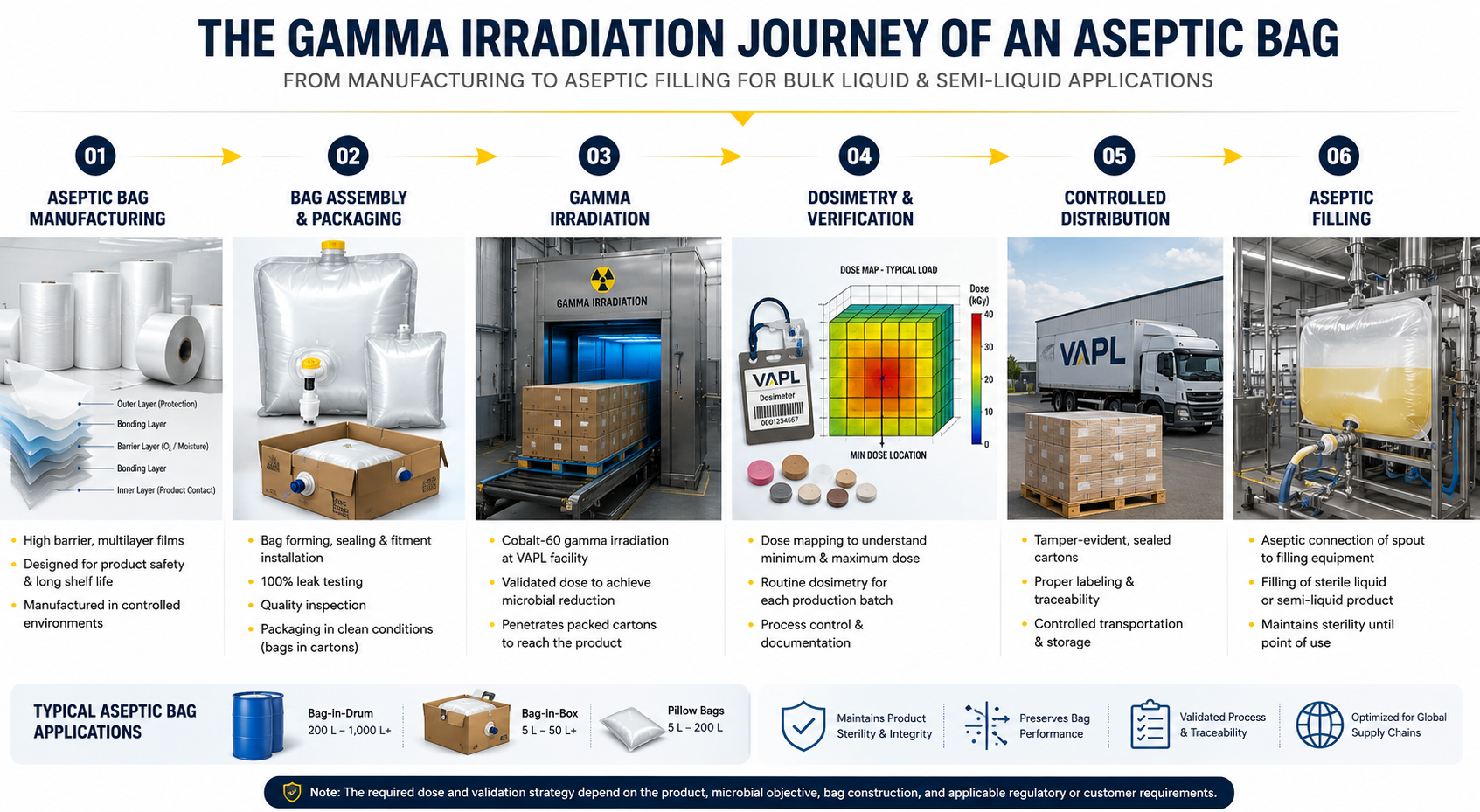
Illustrative process flow. Actual manufacturing, packaging, irradiation, validation and filling requirements depend on the specific aseptic bag design and intended application.
Irradiation Is One Part of a Larger Global Supply Chain
Aseptic bags may move through several specialised stages before reaching the food processor that ultimately uses them. Manufacturing, irradiation, logistics, storage and filling may occur at different locations within the supply chain.
For manufacturers supplying multiple geographic markets, radiation processing therefore becomes both a technical and operational consideration. The irradiation location must support the validated process while integrating effectively with product movement, inventory planning and downstream customer requirements.
Process Consistency
A defined irradiation configuration and controlled process help manufacturers maintain consistency as production volumes increase or products are supplied across different markets.
Capacity & Scalability
For high-volume aseptic bag applications, access to suitable irradiation capacity can become an important operational consideration within the broader supply chain.
Supply-Chain Integration
Irradiation planning can be considered alongside logistics, inventory and distribution requirements while ensuring that technical and validation requirements remain the primary basis of the radiation process.
High-Volume Radiation Processing Requires Technical Control and Operational Reliability.
For aseptic bag manufacturers, the irradiation process begins with understanding the product itself. Bag construction, packaging configuration, load density, dose requirements and expected processing volumes all influence the development of an effective radiation processing strategy.
A technically sound approach combines appropriate dose establishment, dose mapping and routine dosimetry with a repeatable product configuration and controlled processing conditions.
Located within MIHAN Special Economic Zone in Nagpur, India, VAPL provides contract gamma irradiation services together with dose mapping, dose establishment studies and radiation dosimetry for manufacturers evaluating radiation processing for suitable products and packaging systems.