Gamma Sterilisation of Urine Drainage Bags
Key considerations for medical device manufacturers evaluating radiation sterilisation, material compatibility, process validation and scalable terminal sterilisation strategies for urine collection and drainage systems.
A High-Volume Medical Device with Critical Sterilisation Requirements.
Urine drainage bags and urine collection systems are widely used across hospitals, long-term care environments and home healthcare settings. As single-use medical devices intended to collect and manage urinary output, their manufacturing and sterilisation processes require careful control.
For manufacturers producing these devices at commercial scale, the sterilisation strategy must consider far more than microbial inactivation alone. Device materials, tubing, connectors, valves, seals, packaging systems and the final product configuration can all influence the suitability and validation of a sterilisation process.
Where radiation sterilisation is being evaluated, manufacturers must establish that the selected process is appropriate for the complete finished device and can be consistently controlled during routine production.
For high-volume manufacturers, sterilisation is not simply a final manufacturing step. It becomes an integral part of product validation, production capacity and supply-chain continuity.
Understanding the Complete Urine Drainage System.
A urine drainage bag is a multi-component medical device. Sterilisation suitability therefore needs to be considered across the complete assembled product rather than evaluating the collection bag in isolation.
Collection Bag
Flexible polymer film forming the primary reservoir for urine collection.
Inlet Tubing
Flexible tubing connecting the drainage system to the urinary catheter or collection interface.
Connectors
Interfaces designed to provide secure connection between the drainage system and associated components.
Non-Return Valve
Features designed to help minimise reverse flow within the drainage system.
Drainage Outlet
Outlet mechanisms enabling controlled emptying of the collection bag during use.
Primary Packaging
Packaging configuration that must maintain product integrity through sterilisation, handling, transport and storage.
Why the Sterilisation Strategy Matters.
The selection of a sterilisation modality should be considered during product development and manufacturing planning rather than treated solely as a post-production decision.
For urine drainage systems, manufacturers must consider how the sterilisation process interacts with the device materials, functional components, sealed interfaces and final packaging.
Can Urine Drainage Bags Be Gamma Sterilised?
Gamma irradiation is an established radiation sterilisation technology used across a wide range of healthcare products. Its applicability to a specific urine drainage system, however, should be determined through product-specific evaluation and validation.
The response of the finished device to ionising radiation can depend on the polymers, additives, tubing formulations, connectors, valves, adhesives and packaging materials used in the product.
Consequently, manufacturers evaluating gamma sterilisation should assess the complete product configuration and establish that critical functional and material properties remain acceptable following exposure to the intended sterilisation dose range.
Gamma compatibility should not be assumed solely because an individual polymer is commonly used in radiation-sterilised products. The complete device, its material formulations and its packaging system should be evaluated as part of the manufacturer's validation programme.
Material Compatibility Must Be Evaluated Across the Entire Device.
Urine drainage systems can incorporate multiple polymeric and functional components. Radiation response may vary according to polymer chemistry, formulation, additives, processing history and the applied dose. Manufacturers should therefore evaluate the finished device against defined functional and performance requirements.
Flexible Films
Evaluate physical properties, appearance, flexibility and functional performance following irradiation.
Tubing
Consider flexibility, dimensional stability and performance of tubing within the complete drainage system.
Valves & Connectors
Functional components should continue to operate according to their defined performance requirements after processing.
Packaging System
Packaging materials and seals should be assessed for compatibility with processing and intended shelf life.
Material compatibility is only the beginning.
Establishing a controlled radiation sterilisation process also requires consideration of dose establishment, product loading, dose distribution, routine dosimetry and the validation framework supporting ongoing commercial processing.
The Sterilisation Dose Should Be Established for the Product.
Radiation sterilisation should be supported by an appropriate dose establishment approach consistent with the applicable validation framework and the manufacturer's defined sterilisation requirements.
Product bioburden, microbiological characteristics and the selected validation methodology can influence the process used to establish the sterilisation dose.
Manufacturers should therefore avoid assuming that a single irradiation dose automatically applies to every urine drainage bag configuration.
Changes in materials, suppliers, manufacturing processes, packaging configurations or product families may require evaluation within the manufacturer's established change control and sterilisation validation programme.
Product Configuration Influences Dose Distribution.
During gamma irradiation, absorbed dose distribution within a product load can be influenced by product density, carton dimensions, loading configuration and the geometry of the irradiation process.
Dose mapping helps characterise the dose distribution within a defined loading configuration and identify locations associated with minimum and maximum absorbed dose.
Product Density
Density can influence radiation attenuation and dose distribution throughout the product load.
Carton Dimensions
The physical dimensions of the shipper can influence the geometry of irradiation exposure.
Loading Pattern
Defined and reproducible loading configurations support consistent routine processing.
Dose Uniformity
Mapping provides information on the relationship between minimum and maximum dose locations.
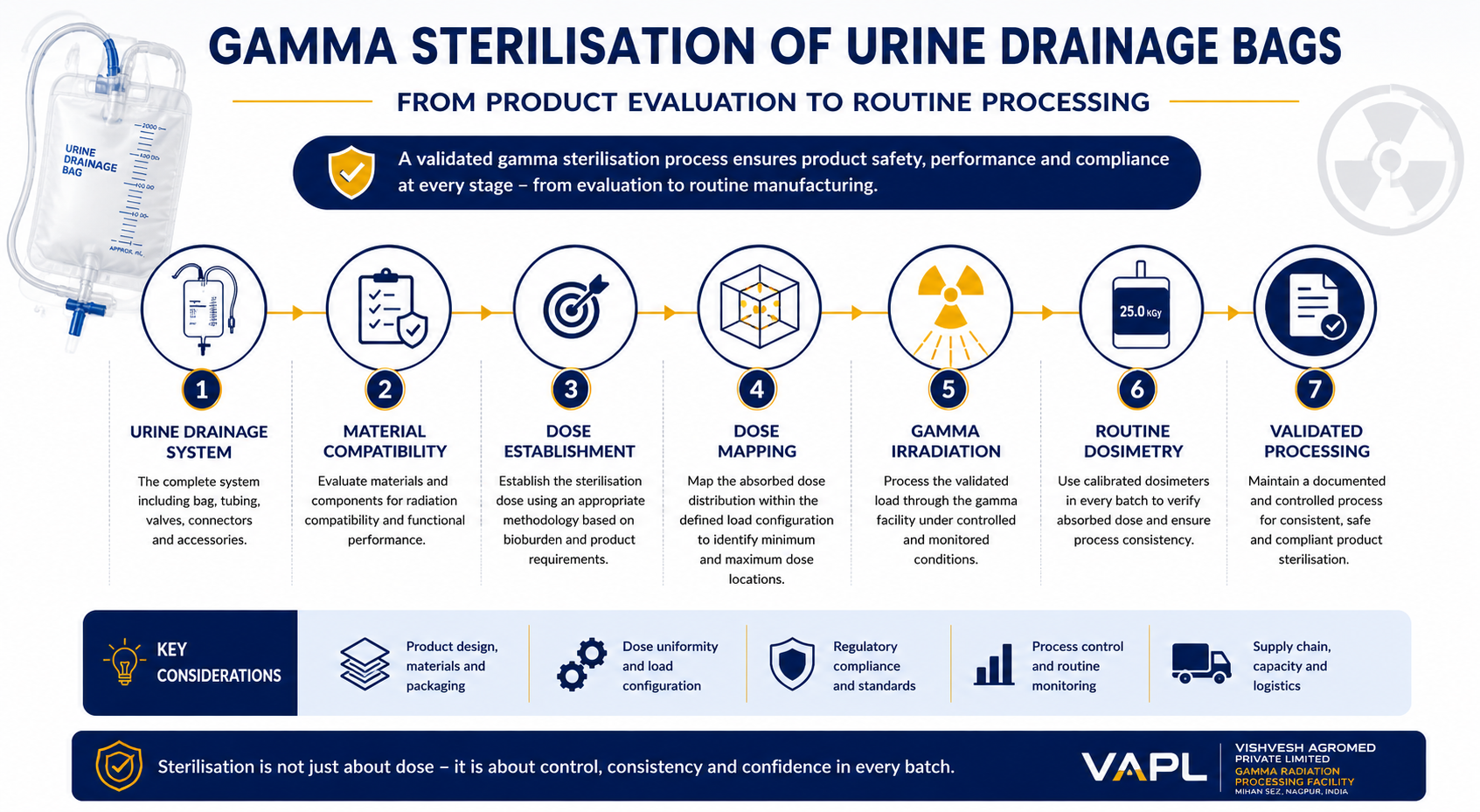
From Product Evaluation to Routine Gamma Sterilisation
Gamma Irradiation or Ethylene Oxide?
Both gamma irradiation and ethylene oxide are established sterilisation technologies used within the medical device industry. Selection should be based on the characteristics of the finished device, its materials, packaging and the manufacturer's validated process requirements.
Gamma Irradiation
Ethylene Oxide
There is no universally superior sterilisation technology for every urine drainage system. The appropriate modality should be selected based on product design, material compatibility, functional requirements and the manufacturer's validated sterilisation strategy.
Scaling Sterilisation for High-Volume Manufacturing.
Urine drainage bags can be manufactured in substantial volumes for domestic healthcare systems and international markets. At this scale, sterilisation capacity becomes closely connected with production planning, inventory management and supply-chain performance.
Manufacturers evaluating an external contract sterilisation partner may therefore need to consider not only technical capability, but also processing capacity, turnaround planning, logistics and the ability to support consistent routine loads.
At commercial scale, sterilisation becomes part of the supply chain.
A validated sterilisation process must ultimately operate within the realities of routine manufacturing. Predictable processing, controlled product configurations and effective logistics can become increasingly important as production volumes grow.
From Development to Routine Radiation Processing.
Radiation sterilisation of healthcare products is supported by established standards addressing the development, validation and routine control of sterilisation processes.
For manufacturers, the objective is to establish a documented and reproducible process that remains controlled throughout commercial production.
Product Evaluation
Assess product configuration, materials and packaging for the intended sterilisation process.
Dose Establishment
Establish the sterilisation dose using an appropriate methodology and defined product requirements.
Dose Mapping
Characterise absorbed dose distribution within the defined product loading configuration.
Routine Processing
Maintain controlled processing parameters, dosimetry and documented routine production practices.
Radiation Processing Built Around the Product.
Effective radiation processing begins with understanding the product, its manufacturing configuration and the technical requirements of the intended sterilisation process.
Vishvesh Agromed Private Limited operates a Gamma Radiation Processing Facility at MIHAN SEZ, Nagpur, supporting manufacturers evaluating and implementing gamma irradiation processes across healthcare and other regulated product categories.
For medical device manufacturers, technical activities may include dose establishment, dose mapping, radiation dosimetry and contract gamma irradiation as part of a defined and validated processing programme.
Frequently Asked Questions
Can urine drainage bags be sterilised using gamma irradiation?
Gamma irradiation can be considered for compatible urine drainage systems. Suitability should be established for the complete finished device, including its materials, functional components and packaging, within the manufacturer's validation programme.
What dose is required to sterilise a urine collection bag?
A universal dose should not automatically be assumed for every product. The sterilisation dose should be established using an appropriate validation methodology based on the product and the applicable radiation sterilisation framework.
Why is dose mapping required?
Dose mapping characterises absorbed dose distribution within a defined product loading configuration and helps identify locations associated with minimum and maximum absorbed dose.
Is gamma irradiation better than ethylene oxide for urine bags?
The appropriate sterilisation modality depends on the specific device, materials, packaging and manufacturing requirements. Both technologies require product-specific evaluation and validated process control.
A sterilisation process is only as strong as the validation behind it.
For urine drainage bag manufacturers evaluating gamma irradiation, the pathway begins with understanding the product, establishing material compatibility and developing a controlled process capable of supporting consistent routine manufacturing.