Gamma Irradiation of Spices: Reducing Microbial Load for Food Safety
Gamma irradiation is used as a microbial control technology for spices and food ingredients. By applying a validated radiation process, manufacturers can address microbial contamination while processing packaged products and supporting consistent food quality.
Spices are naturally exposed to agricultural, environmental, handling and storage conditions that can introduce microorganisms into the finished ingredient. For spice manufacturers, controlling microbial load is therefore an important part of maintaining product quality and meeting applicable microbiological requirements. Gamma irradiation provides a validated physical processing method that can be used to reduce microbial contamination in suitable spice products.
Documented Microbiological Case Study
A microbiology report from the Radiation Processing Plant evaluated seven spice products supplied by Vishvesh Agromed Pvt. Ltd.: turmeric powder, red chilli powder, coriander powder, Kanda Lasun Masala, Goda Masala, Mutton Masala and Meat Masala. Control and irradiated samples were evaluated using microbiological parameters including Total Aerobic Plate Count (TPC), Total Yeast & Mould Count and Total Coliform Count.
Why Microbial Control Matters in Spices
Spices and spice blends are agricultural food ingredients that can carry microorganisms from raw-material handling, processing and storage. Microbiological quality is therefore an important consideration for manufacturers supplying spices to food processors, retailers and consumers.
Gamma irradiation offers a post-processing microbial control option for suitable spice products. The process exposes the product to ionising radiation under controlled conditions, allowing microorganisms to be reduced without requiring the addition of a chemical sterilant.
The effectiveness of any radiation process depends on the product, its initial microbial load, packaging configuration and validated processing conditions. Microbiological testing provides an important means of evaluating the condition of the product before and after processing.
What Was Evaluated in the Spice Study?
The documented microbiology report evaluated seven different spice products and compared control samples with irradiated samples. The testing included three microbiological parameters that provide different indicators of product hygiene and microbial quality.
| Test Parameter | What It Indicates |
|---|---|
| Total Aerobic Plate Count (TPC) | Overall aerobic microbial population measured in the sample. |
| Total Yeast & Mould Count | Presence and level of yeast and mould organisms in the tested sample. |
| Total Coliform Count | Presence of coliform organisms used as a microbiological hygiene indicator. |
Seven Spice Products Evaluated
The study included turmeric powder, red chilli powder, coriander powder, Kanda Lasun Masala, Goda Masala, Mutton Masala and Meat Masala. This provides a useful cross-section of both individual spices and blended masala products for understanding microbiological changes following radiation processing.
Control Sample vs Irradiated Sample
The study compared microbiological results from control samples with corresponding irradiated samples. This type of comparison is useful for assessing the change in microbial counts associated with the radiation processing step.
| Product Group | Control Sample | Irradiated Sample |
|---|---|---|
| Turmeric Powder | Microbiological testing performed | Microbiological testing performed |
| Red Chilli Powder | Microbiological testing performed | Microbiological testing performed |
| Coriander Powder | Microbiological testing performed | Microbiological testing performed |
| Kanda Lasun Masala | Microbiological testing performed | Microbiological testing performed |
| Goda Masala | Microbiological testing performed | Microbiological testing performed |
| Mutton Masala | Microbiological testing performed | Microbiological testing performed |
| Meat Masala | Microbiological testing performed | Microbiological testing performed |
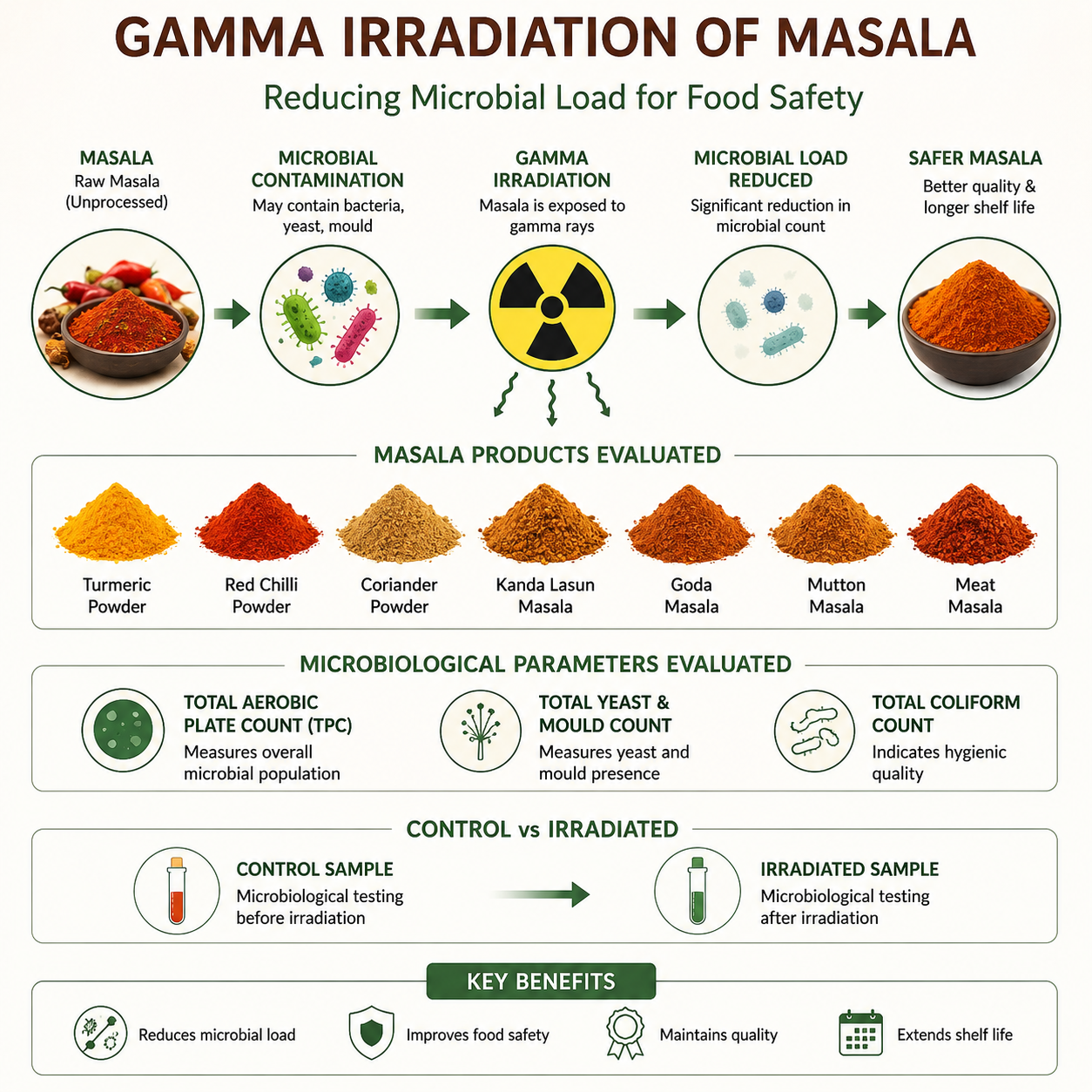
Figure 1. Gamma irradiation of masala and spice products, illustrating microbial load control and microbiological evaluation of control and irradiated samples.
Understanding the Microbiological Results
The microbiology report provides a comparison between control and irradiated samples across the tested spice products. The results are reported in CFU/g and cover Total Aerobic Plate Count (TPC), Total Yeast & Mould Count and Total Coliform Count.
The purpose of this comparison is to observe the microbiological condition of the products following radiation processing. The report therefore provides a practical example of how microbiological testing can be used alongside radiation processing to evaluate microbial quality in spices.
What the Results Tell Us
The control samples provide a baseline for the microbiological condition of the products before irradiation, while the irradiated samples provide the corresponding results following radiation processing. Comparing these two sets of results allows manufacturers to assess the change in microbial counts associated with the processing step.
| Microbiological Parameter | Role in Product Evaluation |
|---|---|
| Total Aerobic Plate Count (TPC) | Provides an indication of the aerobic microbial population present in the tested spice sample. |
| Total Yeast & Mould Count | Provides an indication of yeast and mould levels in the tested product. |
| Total Coliform Count | Provides a microbiological hygiene indicator for the tested sample. |
A Data-Driven Approach to Food Irradiation
Microbiological testing provides an objective way to compare product quality before and after radiation processing. For manufacturers, combining microbiological evaluation with a controlled and validated irradiation process provides a stronger basis for understanding microbial quality.
Gamma Irradiation and Spice Processing
Gamma irradiation uses ionising radiation as a physical processing method. For suitable spice products, the process can be applied to packaged material, allowing microbial control to be incorporated into the product's processing workflow.
The appropriate processing conditions depend on the product and the intended application. Product characteristics, initial microbial load, packaging configuration and the required microbiological outcome all need to be considered when establishing a radiation processing programme.
For this reason, radiation processing should be approached as a controlled technical process rather than as a one-size-fits-all treatment. Product evaluation, dose establishment, dosimetry and microbiological testing all contribute to developing an appropriate processing programme.
From Microbiological Testing to Routine Processing
A successful food irradiation programme begins with understanding the product and its microbiological condition. Manufacturers can then evaluate the appropriate processing requirements and establish controls for routine irradiation.
| Stage | Purpose |
|---|---|
| Product Assessment | Understand the product, packaging and intended processing requirements. |
| Microbiological Testing | Establish the microbial condition of the product and evaluate relevant parameters. |
| Radiation Processing | Process the product under controlled irradiation conditions. |
| Post-Processing Evaluation | Compare microbiological results following irradiation. |
| Routine Process Control | Maintain defined processing and quality controls during commercial operations. |
What Spice Manufacturers Should Consider Before Irradiation
Before sending a spice product for gamma irradiation, manufacturers should evaluate the characteristics of the product, its packaging and the intended microbiological objective. Different spices and spice blends can have different starting microbial loads and processing requirements.
- Product type and composition
- Initial microbiological condition
- Packaging material and configuration
- Product density and loading arrangement
- Target microbiological outcome
- Radiation dose and process validation requirements
- Pre- and post-processing microbiological testing
- Routine process monitoring and dosimetry
Why Microbiological Testing Matters
Microbiological testing is an important part of demonstrating the effect of a food processing intervention. In the documented spice study, control and irradiated samples were examined using TPC, Total Yeast & Mould Count and Total Coliform Count, creating a structured basis for comparison.
The results should be interpreted in the context of the specific products, samples and test conditions covered by the report. They should not automatically be treated as universal results for every spice, batch or irradiation process.
Case Study Perspective
The documented BRIT microbiology report provides a practical example of control-versus-irradiated testing across multiple spice products. It demonstrates how microbiological analysis can be used to evaluate radiation processing outcomes while recognising that each product and processing programme requires its own technical assessment.
Frequently Asked Questions
Why are spices evaluated for microbial load?
Spices are agricultural food ingredients and their microbiological condition can vary depending on raw-material handling, processing and storage. Testing parameters such as TPC, yeast & mould and coliform counts helps manufacturers evaluate microbiological quality.
What is TPC in spice testing?
TPC, or Total Aerobic Plate Count, is a microbiological measurement used to indicate the level of aerobic microorganisms present in a tested sample.
Can gamma irradiation be used for spice blends?
Gamma irradiation can be considered for suitable spice blends as a microbial control process. The appropriate processing conditions need to be established for the specific product, packaging configuration and intended application.
Why compare control and irradiated samples?
A control-versus-irradiated comparison provides a baseline and corresponding post-processing result, allowing manufacturers to evaluate the change in measured microbiological parameters associated with radiation processing.
Conclusion
Gamma irradiation provides food manufacturers with a physical processing option for microbial control in suitable spices and spice blends. The documented microbiology study of turmeric powder, red chilli powder, coriander powder and several masala products demonstrates how control and irradiated samples can be evaluated using TPC, Total Yeast & Mould Count and Total Coliform Count.
For manufacturers considering radiation processing, the most effective approach is to combine product assessment, microbiological testing, appropriate process development and routine control. This helps ensure that irradiation is evaluated according to the specific characteristics and requirements of the product rather than applying a generic treatment.
About Vishvesh Agromed Private Limited
Vishvesh Agromed Private Limited (VAPL) provides gamma radiation processing services for food ingredients, spices, medical devices, pharmaceutical products and other suitable applications. VAPL works with manufacturers to evaluate product requirements and develop controlled radiation processing programmes supported by appropriate technical and quality considerations.
Related Articles
Explore related applications of gamma irradiation across food ingredients, pharmaceutical products and medical devices through the VAPL Knowledge Centre.
- Gamma Sterilisation of Medical & Pharmaceutical Packaging Materials
- Gamma Sterilisation of Rubber Stoppers for Injectable Pharmaceuticals
- Gamma Sterilisation of Single-Use Mixing Systems & Sampling Assemblies
- Gamma Sterilisation of Disposable Manifolds
- Gamma Sterilisation of Aseptic Connectors & Disconnectors
© Vishvesh Agromed Private Limited (VAPL) • VAPL Knowledge Centre